Botswana
December 13, 1985
Botswana. Private meeting place designed and run by artists to meet, discuss ideas, and share work. Short exhibitions and performance by local artists are scheduled by the organizers.
When the alternative Washington exhibition space and lounge called The Tentacle Room run by artist and WPA preparatory Mike McCall (also known as Captain Squid) moved to the west coast, other DC-area artists felt the gap. They filled it with Botswana, a gallery/meeting place/bar to which WPA dedicated space in its galleries at 400 7th Street. The name derived from a label on a scarf worn by Lynn McCary, WPA’s associate director of programs: “made in Botswana,” it read. The choice was appropriate, since, as artist Alan Stone who had just returned from Africa pointed out, the nation of Botswana was a refuge for those fleeing oppression from neighboring South Africa, much as the artists of the Botswana gallery were free from traditional curatorial limitations. Furthermore, as others noted, the nation of Botswana was landlocked, much as Botswana was enclosed within the WPA building and in a sense by the organization itself.
The original core group of artists – including Tom Ashcraft, Dave Brown, Suzanne Codi, Sal Fiorito, Evan Hughes, Charles Sleichter, and Peter Winant – transformed Botswana’s space with a few hundred dollars donated by Peter Carley, who owned a successful plumbing supply business in the area. The group repaired drywall, closed off a stairway for seating, and installed a revolving darkroom door at the entrance. Hughes and another DC artist, Mark Clark, built the soon-to-be famous central feature, the “radar bar,” from a salvaged radar dish. The opening exhibition in December of 1985 was a “trade show,” for which each participating artist – 250 in all – brought one work or found object to swap with another artist. A series of innovative exhibitions and performances quickly followed. Shows were selected by application rather than by résumé: “We didn’t want pedigrees,” Sleichter commented in 2010, “just interesting ideas.” As an artist-driven space, Botswana’s shows were loosely curated by the artists themselves. Each exhibition lasted only a week or so. The only rule, according to McCary, who managed Botswana along with DC artist Paula Schumann, was that artists leave the space as they found it.
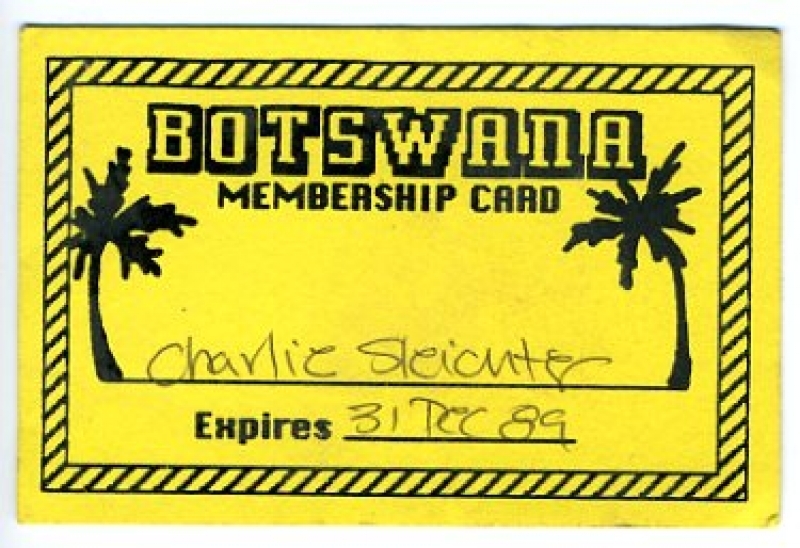
The bar was open two nights a week to Botswana members only, who paid a $5 annual membership fee; Sleichter designed and printed membership cards using a 128K Macintosh computer. Drinks were $1. The bar was staffed by volunteers, who lugged the beer, wine, sodas, and ice up three flights of stairs to the space. Proceeds covered the cost of drinks, maintenance, a stereo system, and a cassette player. Live music was occasionally featured. Botswana’s innovative spirit and ensuing camaraderie attracted visiting artists and curators such as Howard Finster; musicians such as Meredith Monk and John Langford from the Punk band The Mekons, who performed at the 9:30 Club, occasionally stopped by.
In mid-1987, WPA and Botswana relocated temporarily from the Jenifer Building to the former Kresge five-and-dime just up 7th Street while the former space was under renovation. When WPA moved back to the galleries, there was no space for Botswana and it was dissolved. Many of its founders went on to launch a new alternative space, the District of Columbia Arts Center in the Adams Morgan neighborhood.